Zero Export Solar: Why You Don't Need Permits, Utility Approval, or Interconnection Agreements
The secret to installing solar without the red tape? Keep your power on your side of the meter.
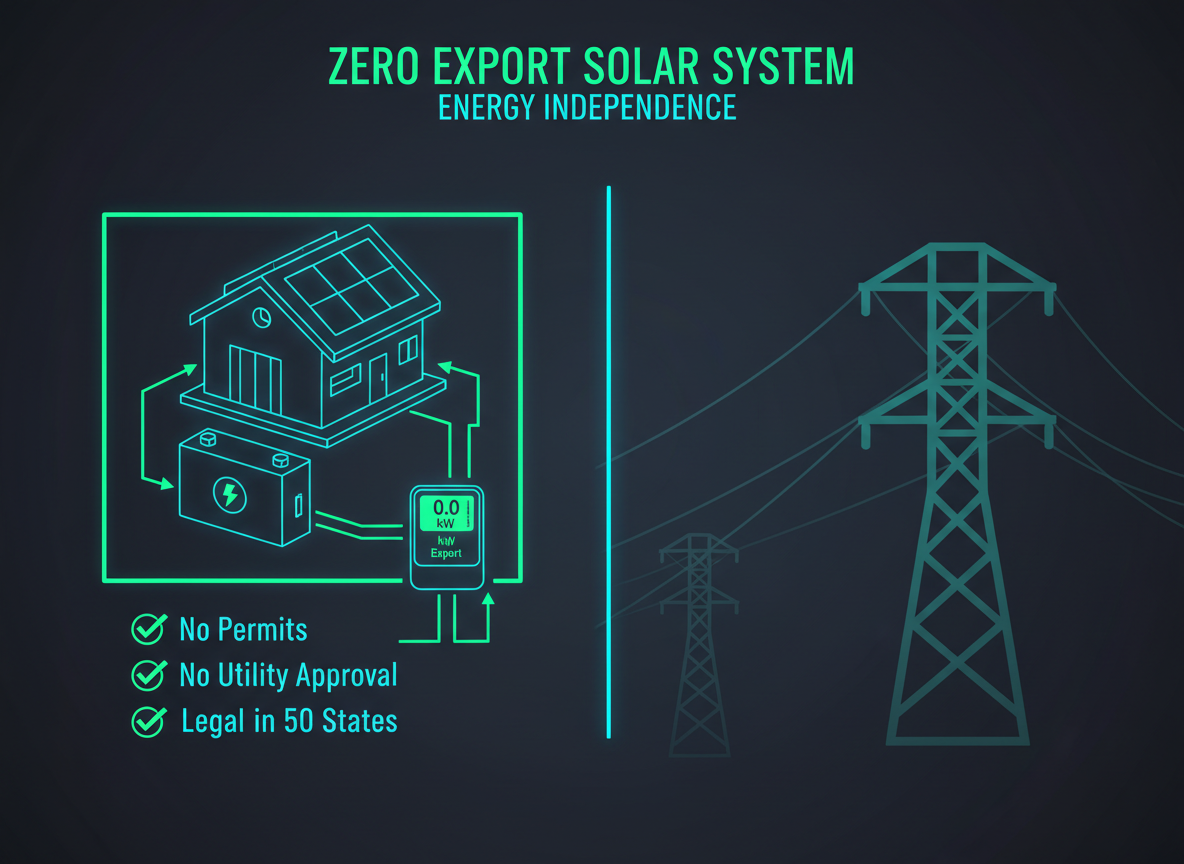
If you have ever looked into installing solar panels, you know the drill: permits, inspections, utility approval, interconnection agreements, and weeks (or months) of waiting. For many homeowners, the bureaucratic maze is enough to kill the dream of energy independence before it even starts.
But here is something most people do not know: none of that is required if your system never exports power back to the grid.
Welcome to zero-export solar—the fastest, simplest, and most hassle-free way to go solar in America. And yes, it is completely legal in all 50 states.
What Is Zero Export Solar?
A zero-export solar system generates electricity from the sun, stores it in a battery, and powers your home—without ever sending a single watt back to the utility grid. The inverter is specifically programmed to prevent backfeed, meaning the utility company never sees your solar power on their lines.
Traditional grid-tied solar systems work differently. When your panels generate more power than you are using, the excess flows back into the grid. Your meter spins backward, and you get credits from the utility (net metering). Sounds great, right? The problem is that connecting to the grid triggers a cascade of regulatory requirements.
Why Grid-Tied Solar Requires So Much Paperwork
When you export power to the grid, you are essentially becoming a small power producer. Utilities have legitimate safety concerns: they need to ensure your system will not backfeed during an outage (which could electrocute line workers), that your equipment meets their standards, and that your installation is safe.
This means:
- Electrical permits from your local building department
- Inspections before and after installation
- Interconnection agreements with your utility company
- Utility approval before you can flip the switch
- Potential HOA approval in some communities
The timeline? Anywhere from 4 weeks to 6 months, depending on your location and utility. And if anything goes wrong in the approval process, you are stuck waiting while your panels sit idle on your roof.
Your Side of the Meter, Your Rules
Here is the key insight that changes everything: utilities only have jurisdiction over what connects to their grid. They regulate the flow of electricity on their side of the meter. But on your side of the meter? That is your property, your electrical system, and your business.
Think about it: you do not need utility approval to plug in a space heater, run a generator, or charge a battery from a wall outlet. As long as you are not sending power back to the grid, the utility has no say in what you do with electricity inside your home.
Zero-export solar works the same way. Your solar panels charge a battery. Your battery powers your home. The grid connection remains unchanged—you still draw power from the utility when you need it, just like before. But you are also generating and storing your own power, completely independent of utility oversight.
Legal in All 50 States
Because zero-export systems do not interact with the grid, they fall outside the regulatory framework designed for grid-tied solar. There are no federal laws restricting what you do with electricity on your side of the meter, and no state has passed legislation prohibiting zero-export solar systems.
This is not a loophole or a gray area. It is simply how electrical regulations work. Utilities regulate grid connections. If you are not connecting to the grid (or more precisely, not exporting to the grid), their regulations do not apply.
Some local jurisdictions may have specific rules about electrical work, but plug-in solar systems that do not require hardwiring typically fall below the threshold for permits. Always check your local codes, but in the vast majority of cases, a true plug-and-play zero-export system requires no permits whatsoever.
How Craftstrom + Anvil Makes Zero Export Simple
The Craftstrom + Anvil PowerStack system is designed from the ground up as a zero-export solution. Here is how it works:
- Craftstrom solar panels capture energy from the sun
- Anvil PowerStack battery stores the energy using efficient DC-to-DC charging
- Craftstrom inverter converts stored DC power to AC for your home
- Standard plug connects to any outlet in your home
The inverter is programmed to never backfeed the grid. It monitors the connection and ensures that power only flows one direction: from your battery to your home. If your battery is full and your panels are still generating, the system simply throttles back—no export, no grid interaction, no utility involvement.
Who Is Zero Export Solar Perfect For?
Zero-export solar is ideal for anyone who wants the benefits of solar without the bureaucratic headaches:
- Renters who cannot make permanent modifications to their home
- Homeowners in strict HOA communities where solar approval is difficult
- People who value privacy and do not want utility companies monitoring their generation
- Anyone frustrated with permit delays and utility red tape
- DIY enthusiasts who want to install their own system
- Backup power seekers who want solar + battery without grid complexity
The Trade-Off: No Net Metering Credits
There is one trade-off with zero-export solar: you do not get net metering credits for excess generation. With a grid-tied system, surplus power earns you credits that offset your utility bill. With zero-export, any power you do not use or store is simply not generated (the system throttles back).
For most homeowners, this trade-off is worth it. The Anvil PowerStack offers enough storage capacity that you can capture most of your solar generation and use it when you need it—morning, evening, or during an outage. And you avoid months of permit delays, utility negotiations, and inspection appointments.
Getting Started with Zero Export Solar
Ready to generate your own power without asking permission? Here is how to get started:
- Assess your energy needs – How much power do you use daily? The battery sizing guide can help.
- Choose your Craftstrom solar kit – Match your roof space and budget
- Select your Anvil PowerStack – PowerCore, PowerPro, or PowerMax based on storage needs
- Install and plug in – No permits, no waiting, no utility approval
The entire process can be completed in a single weekend. Compare that to the months-long timeline for traditional grid-tied solar, and the appeal of zero-export becomes obvious.
The Bottom Line
Zero-export solar is not a workaround or a hack. It is a legitimate, legal approach to energy independence that sidesteps the regulatory complexity of grid-tied systems. By keeping all your power on your side of the meter, you maintain full control over your energy—no permits, no utility approval, no interconnection agreements.
The Craftstrom + Anvil PowerStack system makes zero-export solar simple, affordable, and accessible to anyone. Whether you are a renter, a homeowner tired of utility red tape, or simply someone who values energy independence, zero-export solar offers a path forward that does not require asking anyone for permission.
Your side of the meter. Your power. Your rules.
Ready to go solar without the red tape?
Learn how Craftstrom + Anvil can power your home—no permits required.